Step 1 - Understanding your AML obligations
Last updated: May 25, 2026
Learning objectives
By the end of this step, you will:
Understand what anti money laundering means for your business,
Why it matters beyond licensing,
What regulators expect from early stage start-ups.
By the end of this module, you’ll have a clear roadmap of where to focus today and the confidence that you’re building your future on the right foundations.
Introduction: Why this matters
If you are building or scaling a FinTech business, you will hear the term AML early and often. It is frequently presented as a regulatory requirement, a licensing hurdle, or a checklist item. That framing often creates anxiety and confusion, especially for early-stage teams.
This module is designed to remove that uncertainty. Instead of focusing on rules and documents, we will focus on expectations. Regulators are not looking for perfection at this stage. They are looking for understanding, intent, and a credible foundation you can build on.
Before moving forward with this program, it is important that you understand what AML aims to achieve and how it applies to your business today.
Section 1: What AML actually means in practice
An anti-money laundering program refers to the policies, controls, and processes that help prevent criminals from using financial products and services to move or disguise illicit funds.
For a FinTech company, an AML program is not a single document or a single tool. It is a framework that shapes how you think about risk across the customer lifecycle. This includes how you onboard customers, assess their risk, monitor activity over time, and respond when something does not look right.
At an early stage, AML is primarily about decision-making. Regulators want to see that you understand how your product could be misused and that you are making reasonable choices to reduce that risk.
Pause and reflect.
If someone asked you today what AML means for your business specifically, could you explain it in a few sentences without using legal language?
If you would like a concise reference definition, this article provides a clear overview of what AML is and how it applies across financial services.
Section 2: How money laundering happens and why fintechs are exposed
Money laundering is generally described as activity designed to conceal the true origin of criminal proceeds so they appear legitimate.
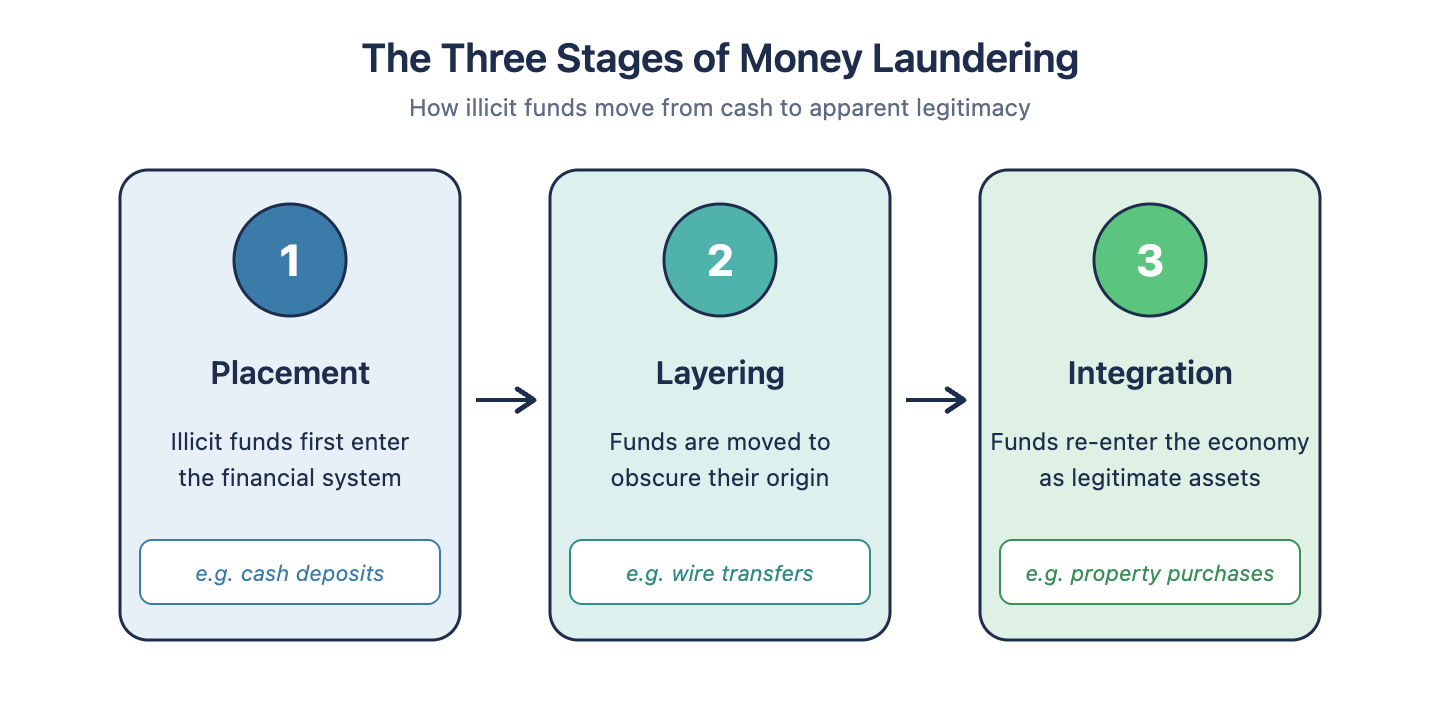
It is often explained through three stages:
Placement is when illicit funds first enter the financial system.
Layering is when those funds are moved or transferred to make them harder to trace.
Integration is when the funds are reintroduced into the economy as apparently legitimate assets.
FinTech products can be attractive during these stages because they often emphasize speed, convenience, digital access, and cross-border capability. This does not mean FinTechs are doing something wrong. It means regulators expect fintechs to understand where their products may be vulnerable.
The goal of AML is not to eliminate all risk. It is to understand how risk could arise and to put reasonable controls in place to manage it.
Section 3: Why AML matters beyond licensing
Many companies first engage seriously with AML when they are applying for a license or working with a regulated partner. This can create the impression that AML exists only to satisfy regulators.
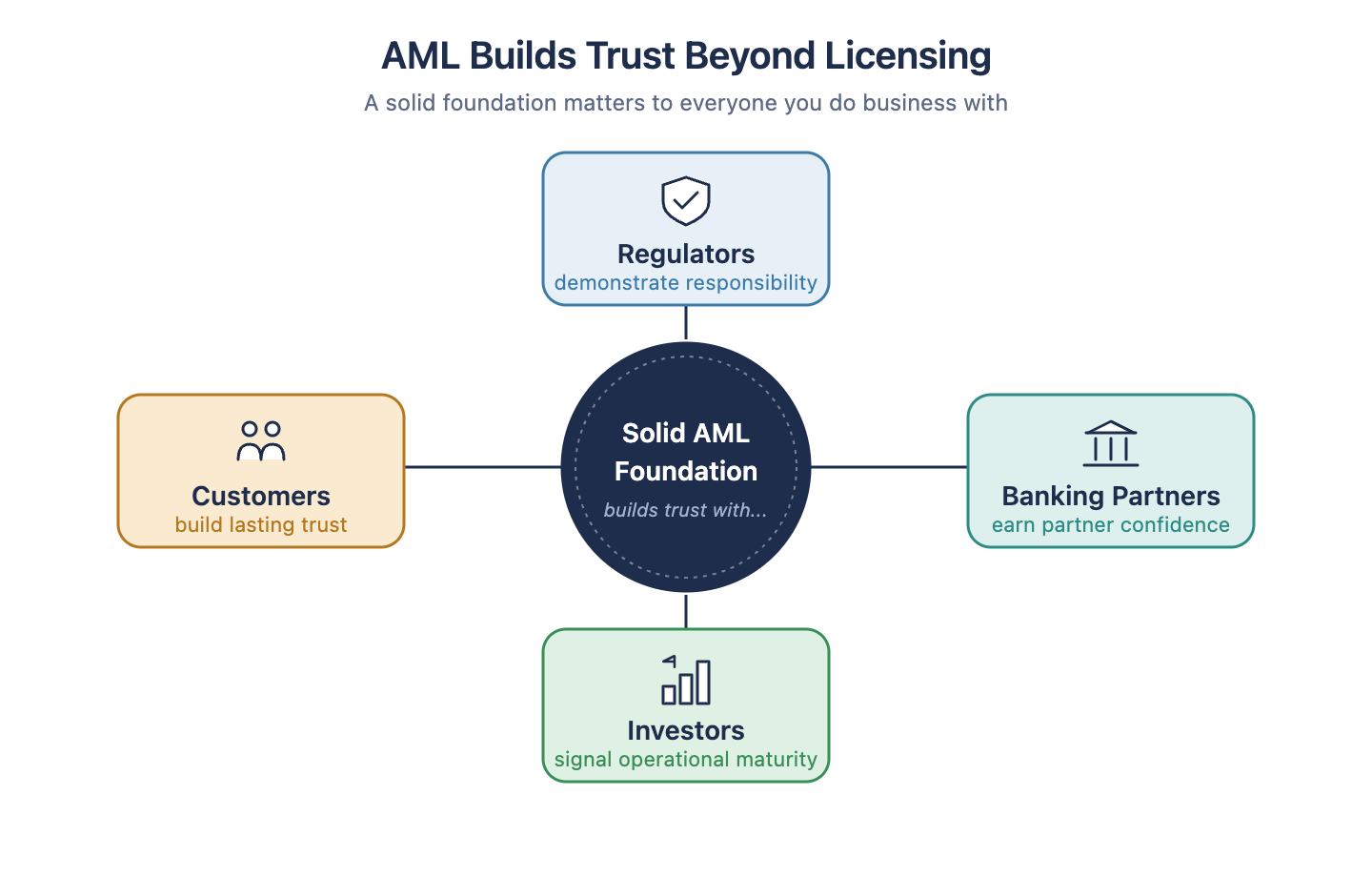
In reality, AML plays a broader role. A well-designed AML foundation helps you build trust with regulators, banking partners, investors, and customers. It reduces the likelihood of major remediation later and makes it easier to scale without rebuilding your program from scratch. Everybody wants to do business with a partner who is safe to do business with.
From a regulatory perspective, AML is a signal. It shows whether a company understands its responsibilities and whether leadership takes financial crime risk seriously.
From a business perspective, AML supports sustainable growth.
Section 4: Which regulations typically apply and who enforces them
The specific AML obligations that apply to your business depend on where you operate, the products you offer, and your customers.
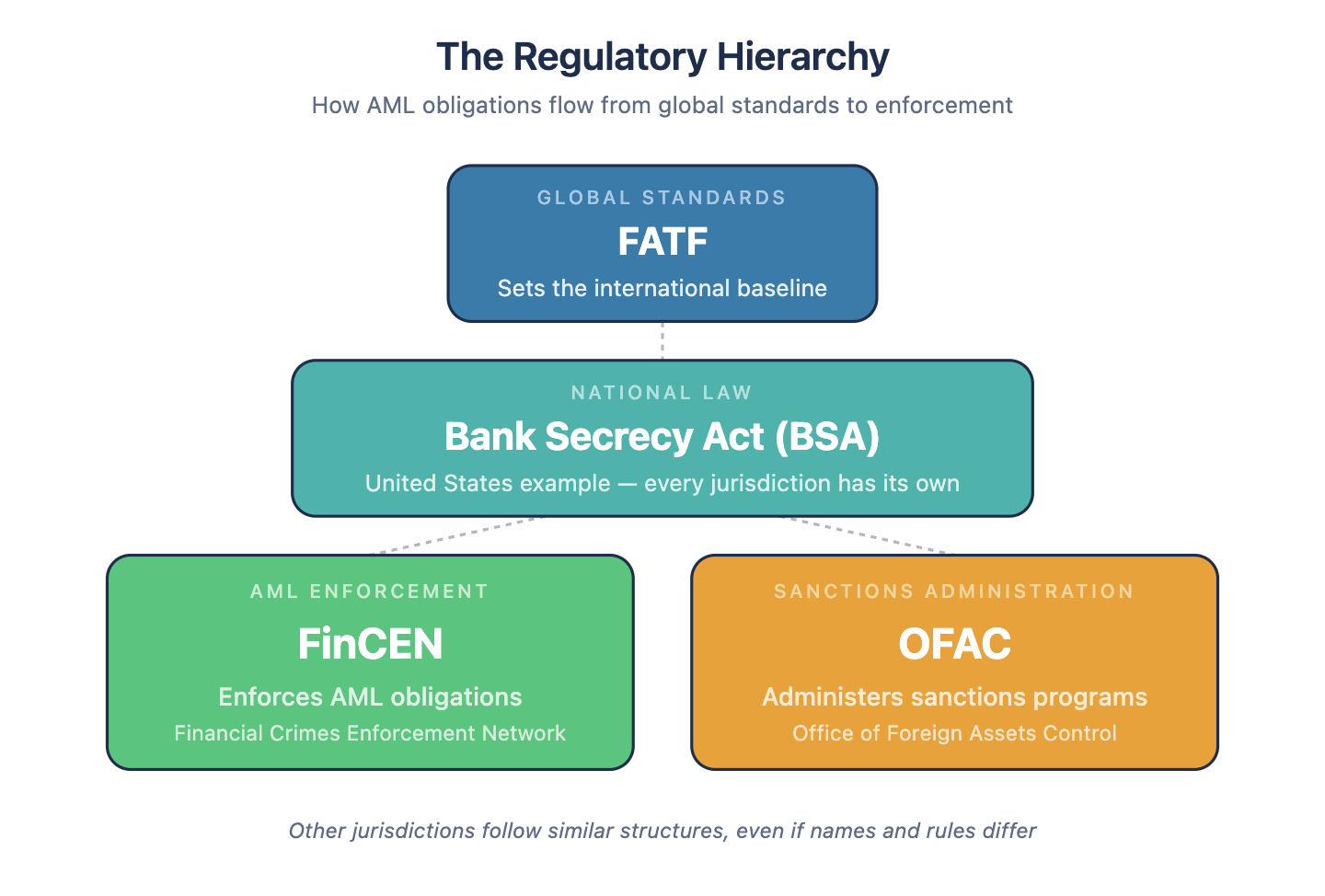
That said, most AML frameworks are influenced by international standards set by the Financial Action Task Force (FATF).
These standards are implemented through national laws and enforced by local regulators.
In the United States, for example:
AML requirements are grounded in the Bank Secrecy Act (BSA) and enforced by the Financial Crimes Enforcement Network (FinCEN).
Sanctions, on the other hand, are administered by the Office of Foreign Assets Control (OFAC).
Other jurisdictions follow similar structures, even if the names and rules differ.
At this stage, you are not expected to master every regulation. You are expected to know which regulatory regime applies to you and to demonstrate awareness of your core obligations.
This article provides additional context on how AML requirements are implemented across different jurisdictions.
Section 5: What regulators expect at an early stage versus later
One of the most common misunderstandings about AML is the belief that regulators expect fully mature programs from day one.
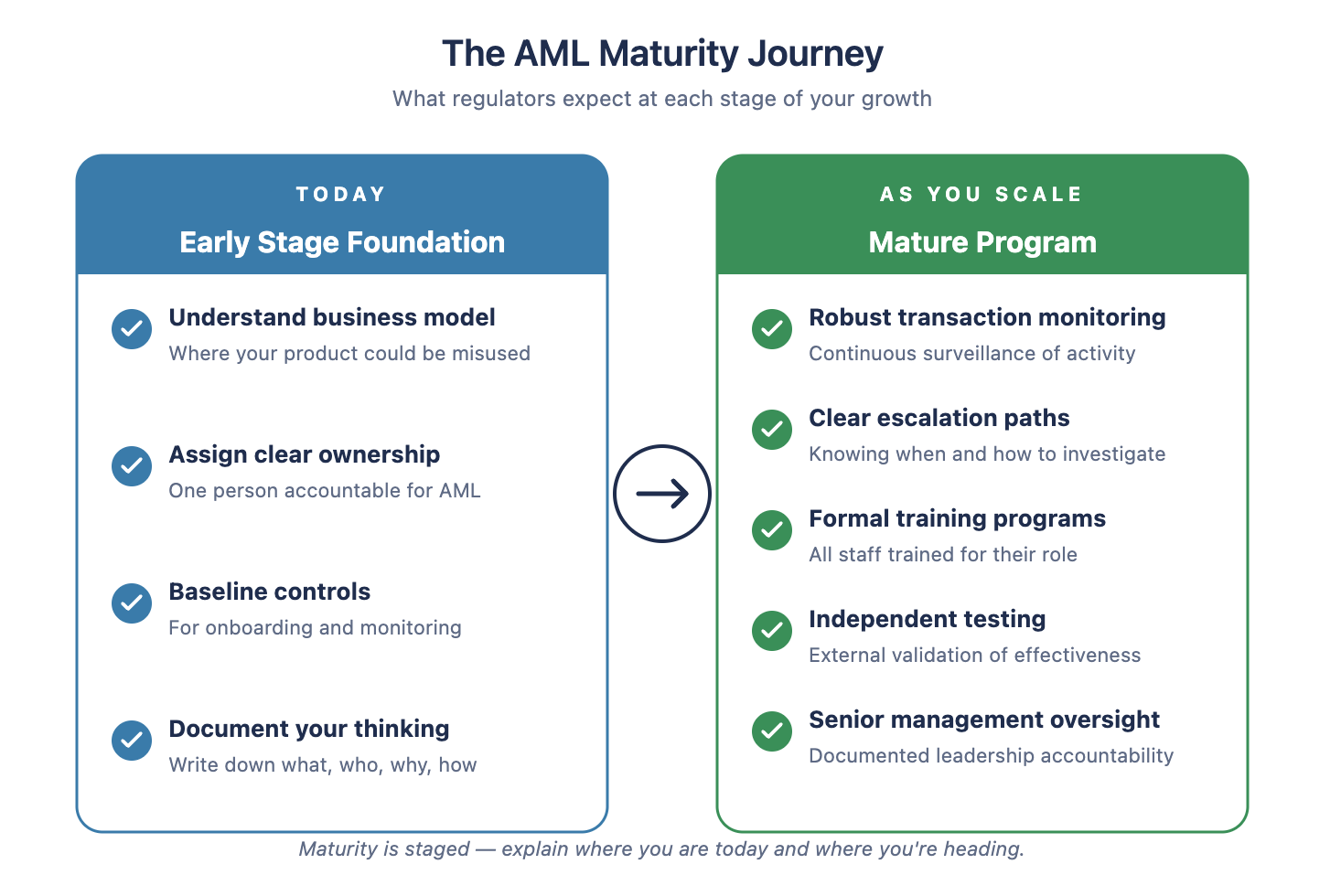
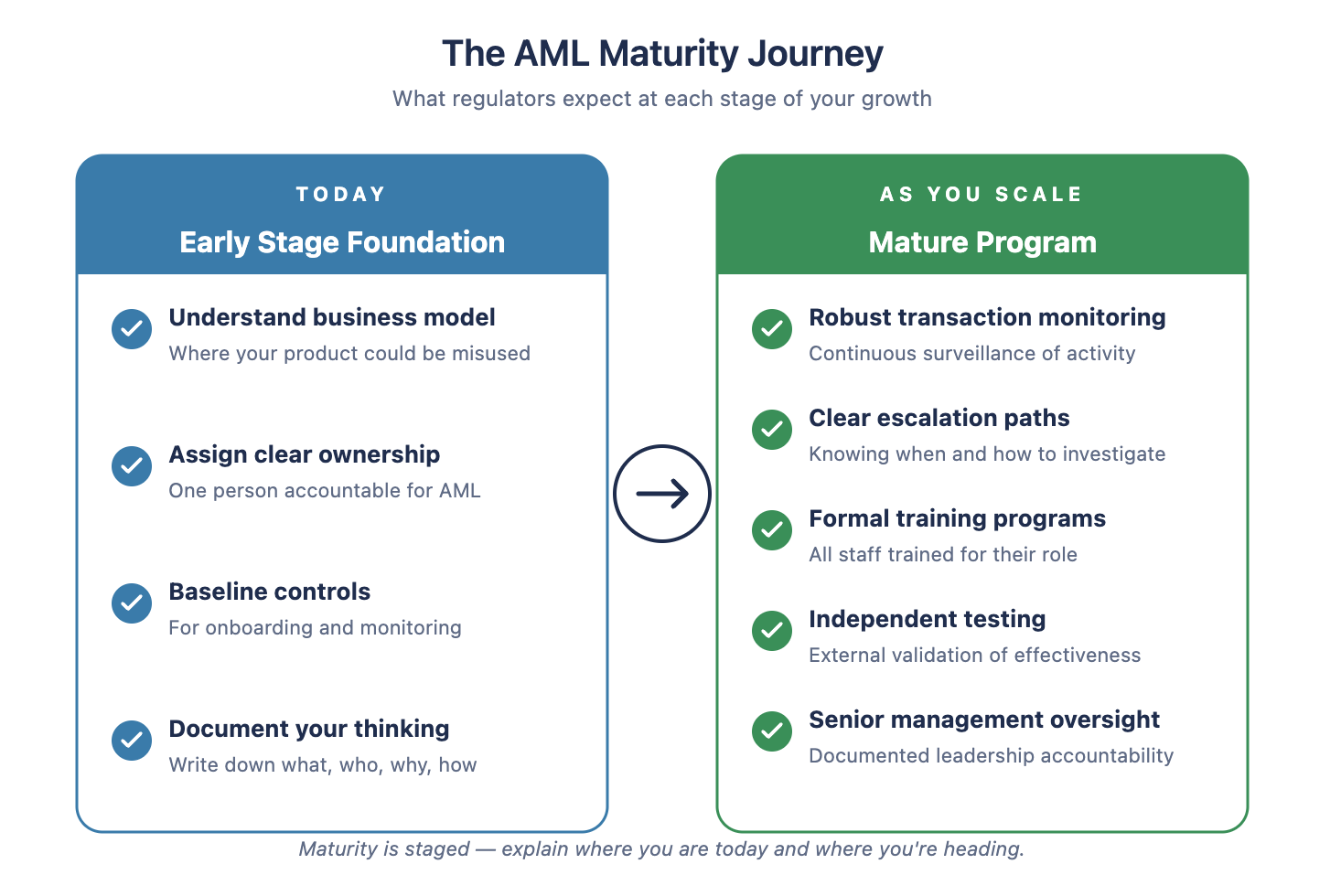
In practice, regulatory expectations are staged.
At an early stage, regulators typically expect you to:
Understand your business model and its risks,
Assign clear ownership for AML,
Establish baseline controls for onboarding and monitoring,
Document your thinking.
Even a simple written AML policy can meet expectations if it explains what you are trying to prevent, who is responsible, and how the program will evolve as the business grows.
As your company scales, expectations expand. Regulators will look for more robust monitoring, clearer escalation paths, formal training, independent testing, and documented senior management oversight.
What matters most is that you can explain where you are today and how you plan to mature over time.
Section 6: Where to focus right now
At this point in your journey, your goal is not to implement everything. Your goal is to build clarity.
You should focus on understanding which AML obligations apply to your business, identifying where your highest risk exposure is likely to be, and establishing a foundation that you can justify and build on. This program is designed to guide you through that process step by step, starting with a risk-based approach in the next module.
Learning checkpoint: What good looks like after step 1
At the end of this module, you should feel grounded rather than overwhelmed.
You should be able to:
Explain what anti money laundering means for your business and why it matters beyond licensing.
Understand which regulators and regulations are relevant to you, even if you are not yet fluent in every detail.
Most importantly, you should be able to describe what regulators expect from an early stage company and how those expectations will change as your business grows.
If you can explain your current position and your intended direction, you are meeting early regulatory expectations.
When you are comfortable with these concepts, you are ready to move on to defining a risk-based approach in the next step of the program.