Step 5 - Understanding sanctions, politically exposed persons, and adverse media
Last updated: May 13, 2026
Learning objectives
By the end of this module, you will
Understand what sanctions, politically exposed persons, and adverse media represent as risk signals,
Why they exist, and how they fit together within an AML program.
Be able to explain when sanctions screening alone is not enough and how different risk types inform decision-making.
You’ll wrap up this module with a deeper understanding of compliance’s various risk signals, allowing you to build a more nuanced and effective strategy.
Introduction: Why different risk types exist
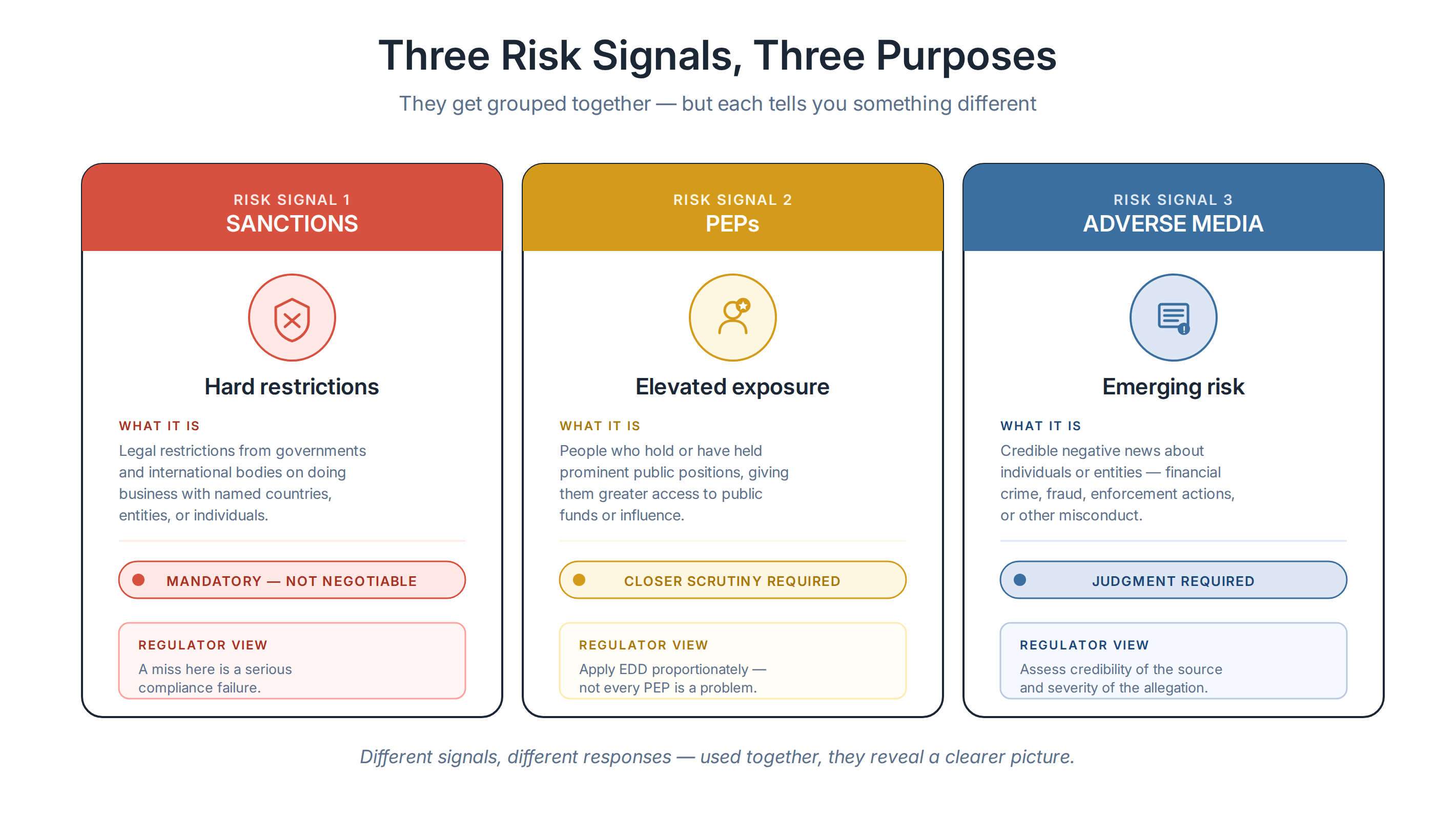
Sanctions, politically exposed persons, and adverse media are often grouped together in onboarding discussions. While they are related, they exist for different reasons and signal different kinds of risk.
This module will help you understand what each risk type is designed to capture and how regulators expect firms to use them together. The goal is not to treat every match as a problem, but to understand what each signal means and how it informs your risk assessment.
Section 1: What sanctions screening covers
Sanctions are legal restrictions imposed by governments and international bodies to limit financial activity involving specific countries, entities, or individuals.
Sanctions screening is mandatory. If a customer is subject to sanctions, firms are generally prohibited from engaging in certain transactions or business relationships with them.
Because sanctions lists change frequently, regulators expect firms to screen at onboarding and on an ongoing basis. Failure to identify sanctions exposure is treated as a serious compliance failure.
Sanctions screening is about legal obligation, not risk tolerance.
Section 2: What politically exposed persons are and why they matter
Politically exposed persons (PEPs) are individuals who hold or have held prominent public positions. Their roles may give them greater access to public funds or influence.
PEP status does not mean someone is engaged in wrongdoing. It signals a higher potential exposure to corruption risk and therefore requires closer scrutiny.
Regulators expect firms to identify PEPs and apply enhanced due diligence where appropriate. The level of scrutiny should be proportionate and informed by context, such as the nature of the role and geographic considerations.
The level of scrutiny should be proportionate and informed by context, such as the nature of the role and geographic considerations. For a deeper look at how PEPs are classified into different 'risk classes' and how to manage their relatives and close associates (RCAs), refer to this comprehensive PEP landscape guide.
Section 3: What adverse media indicates
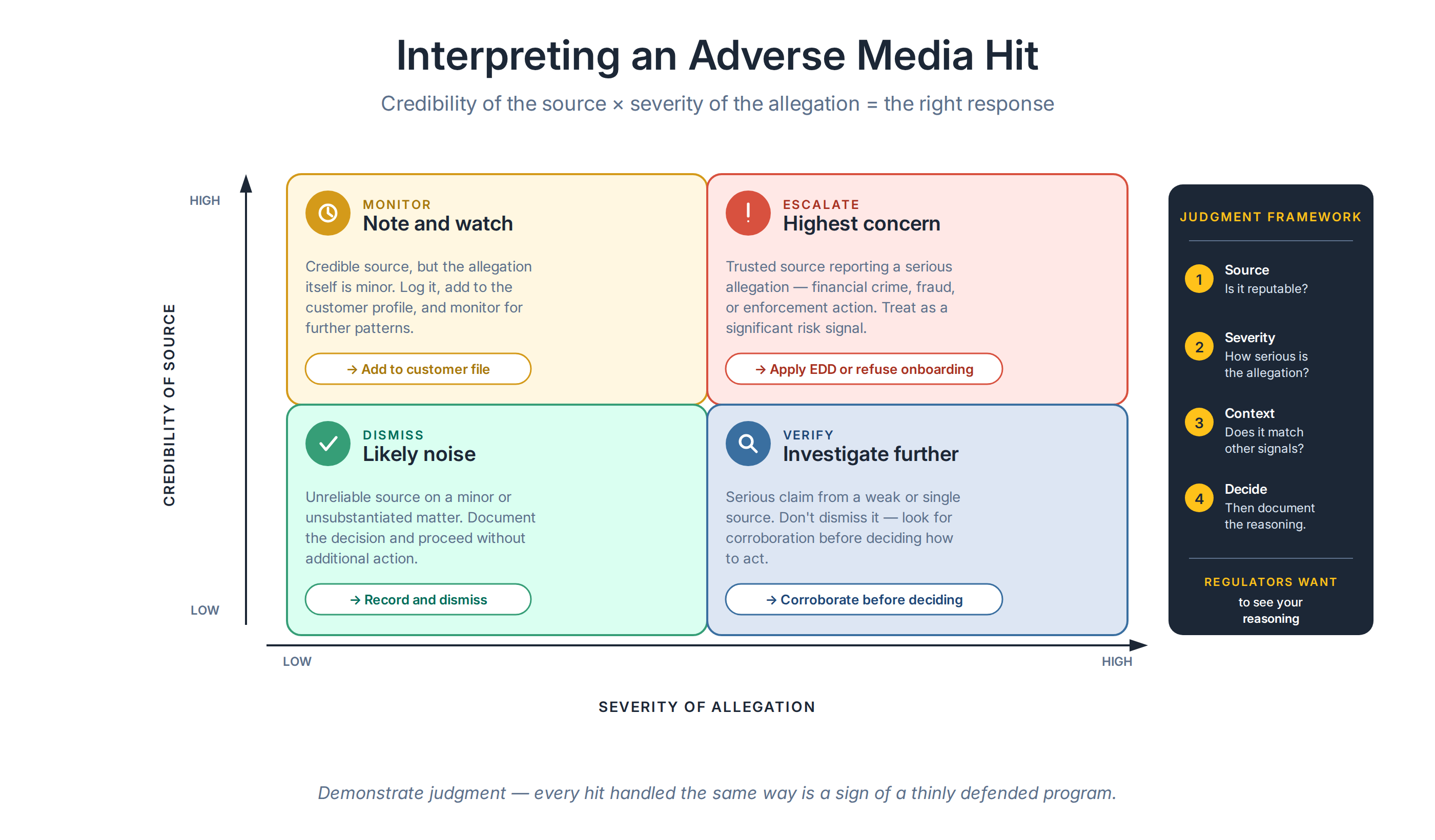
Adverse media refers to credible negative information about individuals or entities reported by reliable sources. This may relate to financial crime, regulatory enforcement, fraud, or other relevant misconduct.
Adverse media is not a legal prohibition like sanctions. It is a risk signal that requires interpretation.
Regulators expect firms to demonstrate judgment when assessing adverse media. This includes considering the credibility of the source and the severity of the allegations.
You can find more on how to categorize negative news results to ensure you are focusing on credible risk signals rather than just 'noise.
Section 4: How these risk types fit together
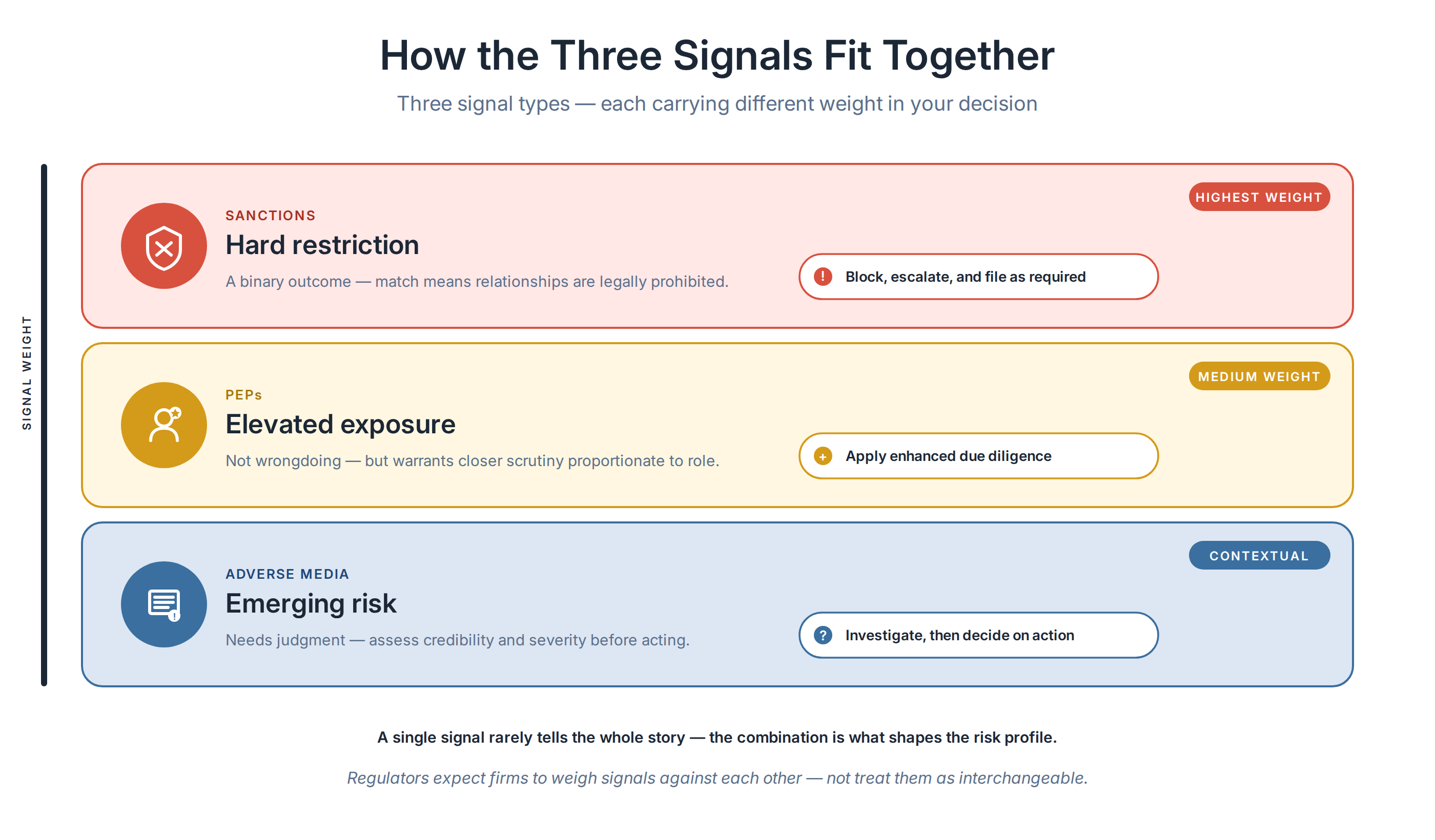
Sanctions, PEPs, and adverse media are not interchangeable. Each serves a different purpose within an AML program.
Sanctions represent hard restrictions.
PEP status represents elevated exposure.
Adverse media represents potential or emerging risk.
A single signal does not automatically determine the outcome. Regulators expect firms to consider how these signals interact and how they affect the overall customer risk profile.
This is where a risk-based approach becomes critical.
Section 5: When sanctions screening alone is not enough
Relying solely on sanctions screening creates blind spots. Many enforcement actions involve customers who were not sanctioned but still posed a significant risk.
PEP identification and adverse media screening help firms identify risk that sanctions lists do not capture. Regulators expect firms to explain why they use multiple data types and how each contributes to risk assessment.
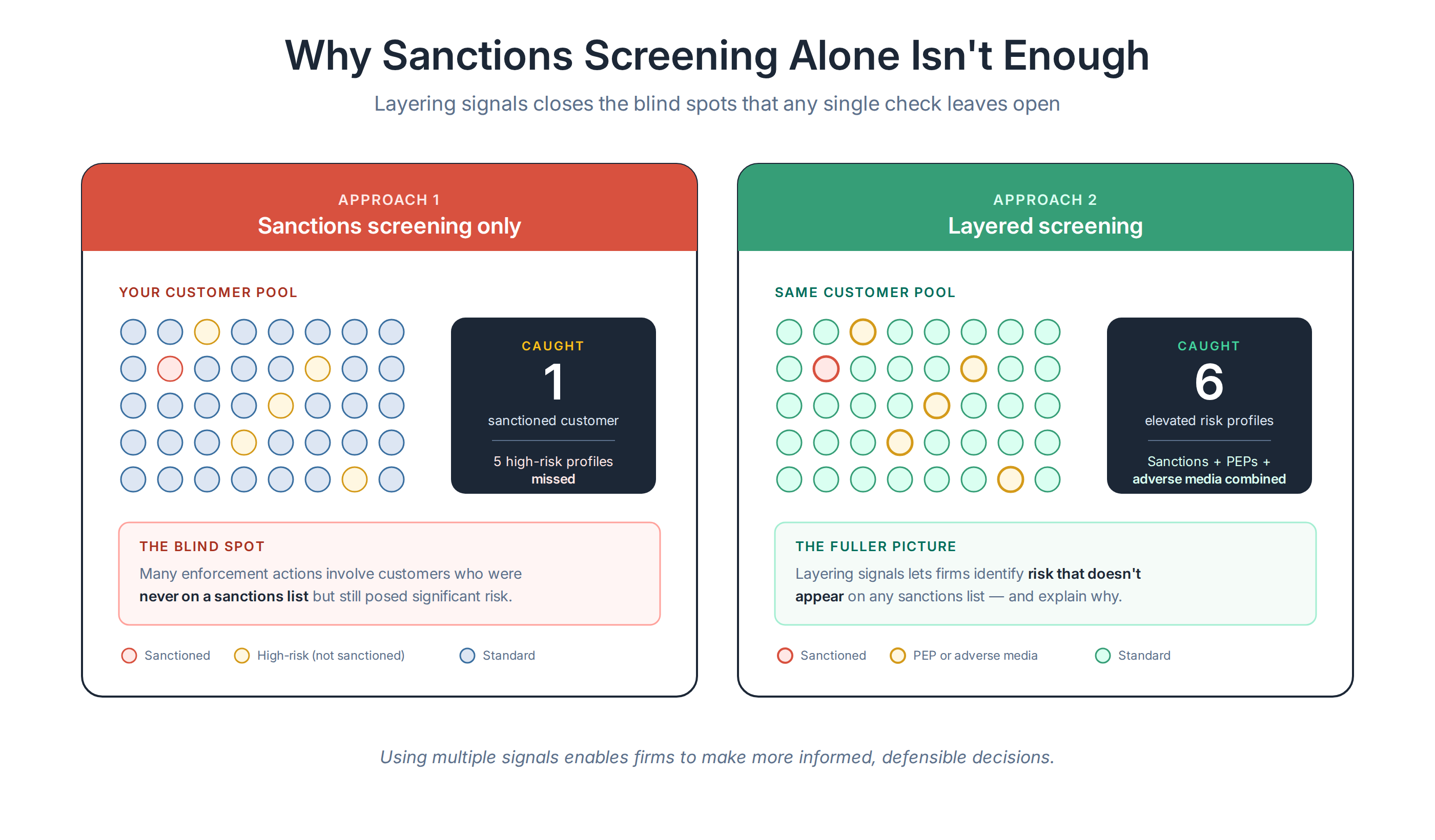
Using multiple signals enables firms to make more informed, defensible decisions.
Learning checkpoint: What good looks like after step 5
At the end of this module, you should be able to
Explain the difference between sanctions, politically exposed persons, and adverse media in plain language.
Understand why sanctions screening is mandatory and why additional risk indicators are necessary.
Identify how these signals inform enhanced due diligence decisions.
If you can describe how different risk types fit together within your AML framework, you are meeting regulatory expectations at this stage.
Preparing for step 6
In the next module, you will move beyond onboarding to understand ongoing monitoring and why customer risk does not remain static over time.