Step 9 - Training, ownership, and accountability
Last updated: May 14, 2026
Learning objectives
By the end of this module, you will understand:
How AML responsibilities are owned across the organization,
What training regulators expect for different roles,
How accountability is established as the business scales.
The main objective of this article is for you to be able to clearly explain who is responsible for what and why.
Introduction: Why governance matters
An AML program does not live in policies or systems alone. It lives in people.
Regulators consistently look for clear ownership, appropriate training, and evidence that AML responsibilities are understood beyond the compliance function.
This module focuses on how to build shared responsibility without creating unnecessary complexity.
Section 1: The role of the compliance officer
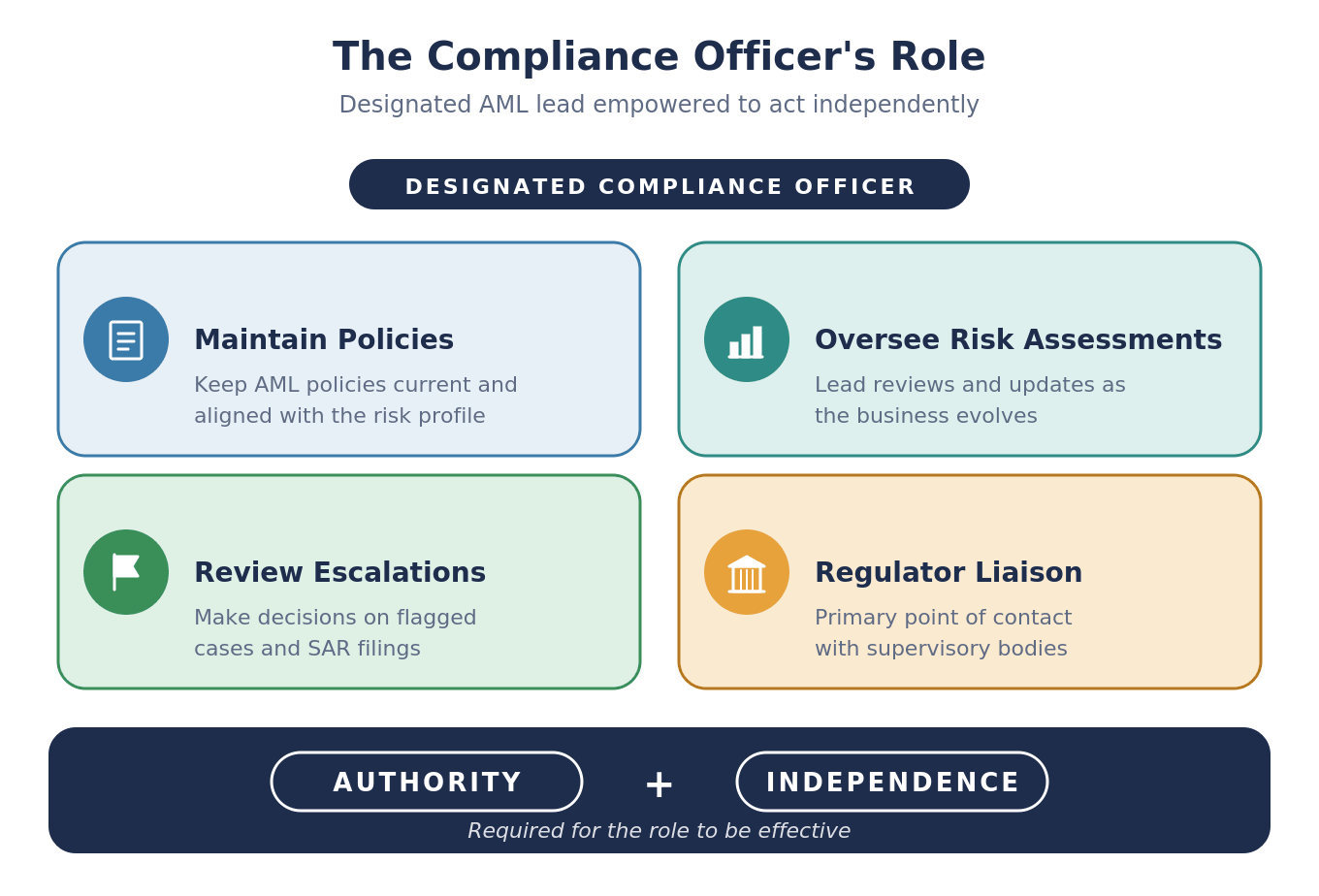
Most regulated firms are required to appoint a designated AML or compliance lead. This role carries accountability for the design and oversight of the AML program.
The compliance officer is responsible for
Maintaining policies,
Overseeing risk assessments,
Reviewing escalations,
Acting as a point of contact for regulators.
Important: this role must have sufficient authority and independence to be effective.
Regulators assess not just whether a compliance officer is appointed, but whether the role is empowered and effective.
Section 2: Training expectations across the organization
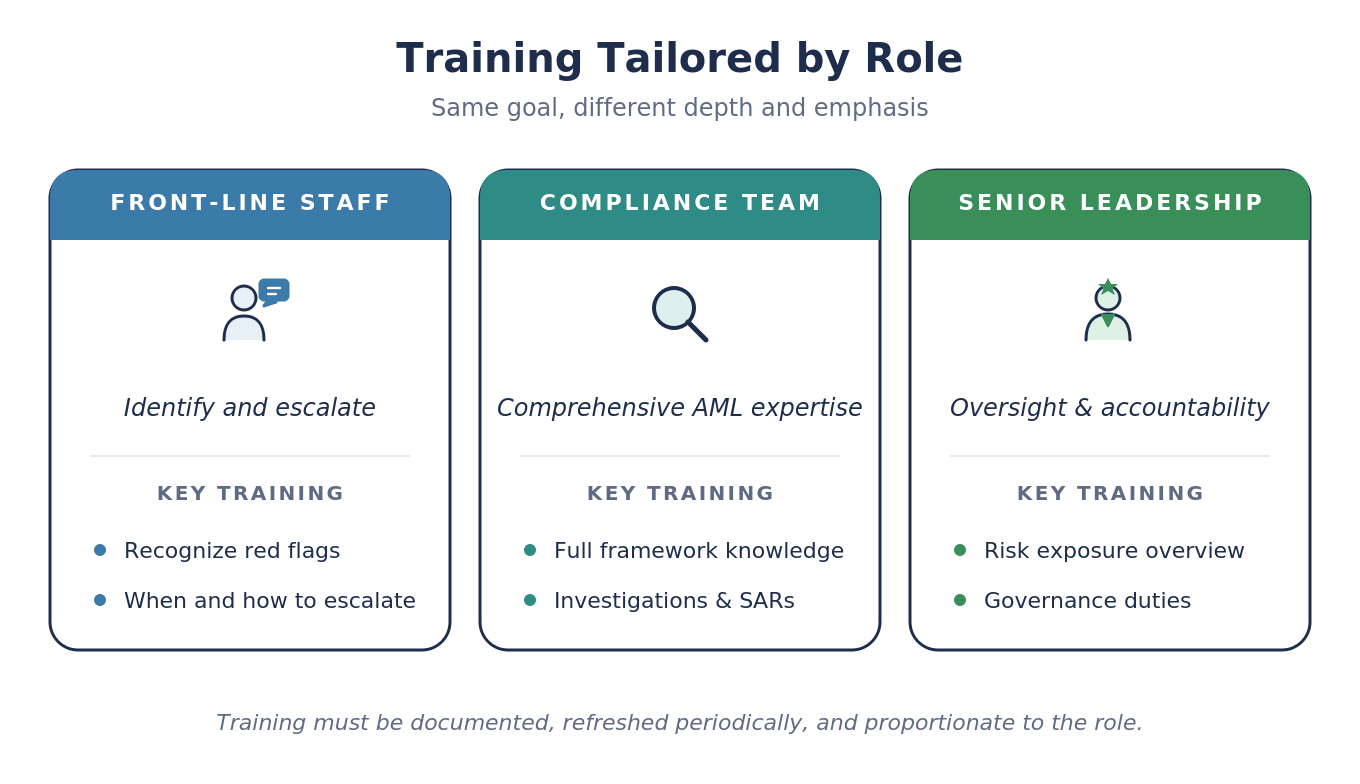
Although compliance professionals must be appointed, AML training is not limited to compliance specialist roles. Regulators expect training to be tailored to each role individuals play within the business.
Training should be relevant, practical, and proportionate.
Those who interact with customers or transactions need to understand how to identify and escalate concerns.
Senior leaders need to understand risk exposure and oversight responsibilities.
etc.
Training does not need to be extensive to be effective, but it must be documented and refreshed periodically.
Pause and reflect.
Reflect on how AML responsibility is shared.
Do team members know what is expected of them in practice?
Would two people describe your AML responsibilities in the same way?
Section 3: Lines of defense and shared responsibility
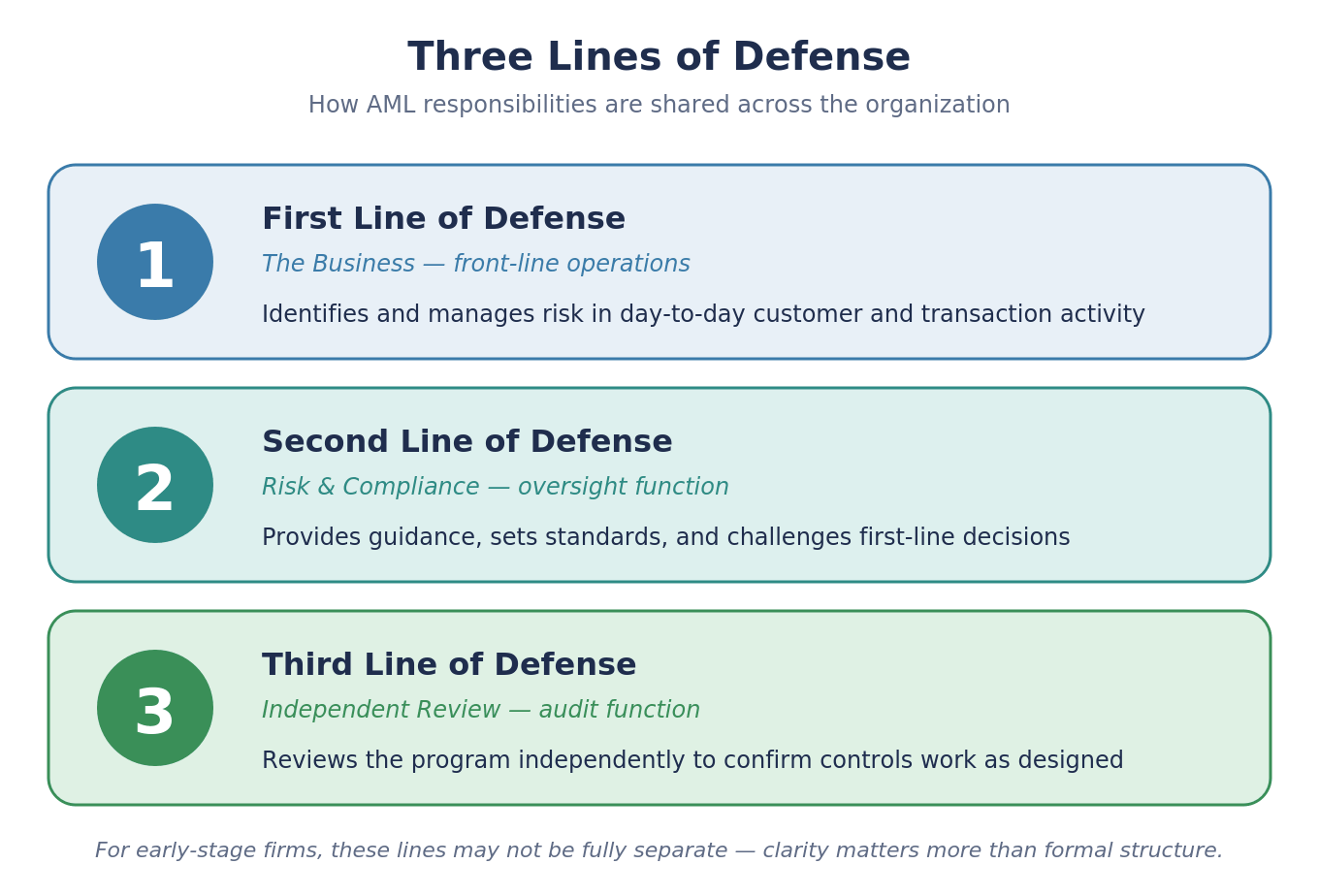
AML responsibilities are often described through the concept of lines of defense. This framework helps clarify who does what and how oversight is maintained.
In practice, this typically means:
The first line identifies and manages risk in day-to-day operations.
The second line provides oversight, guidance, and challenge.
The third line provides an independent review.
For early-stage firms, these lines may not be fully separate. What matters is clarity, not formal structure.
Section 4: Building accountability early
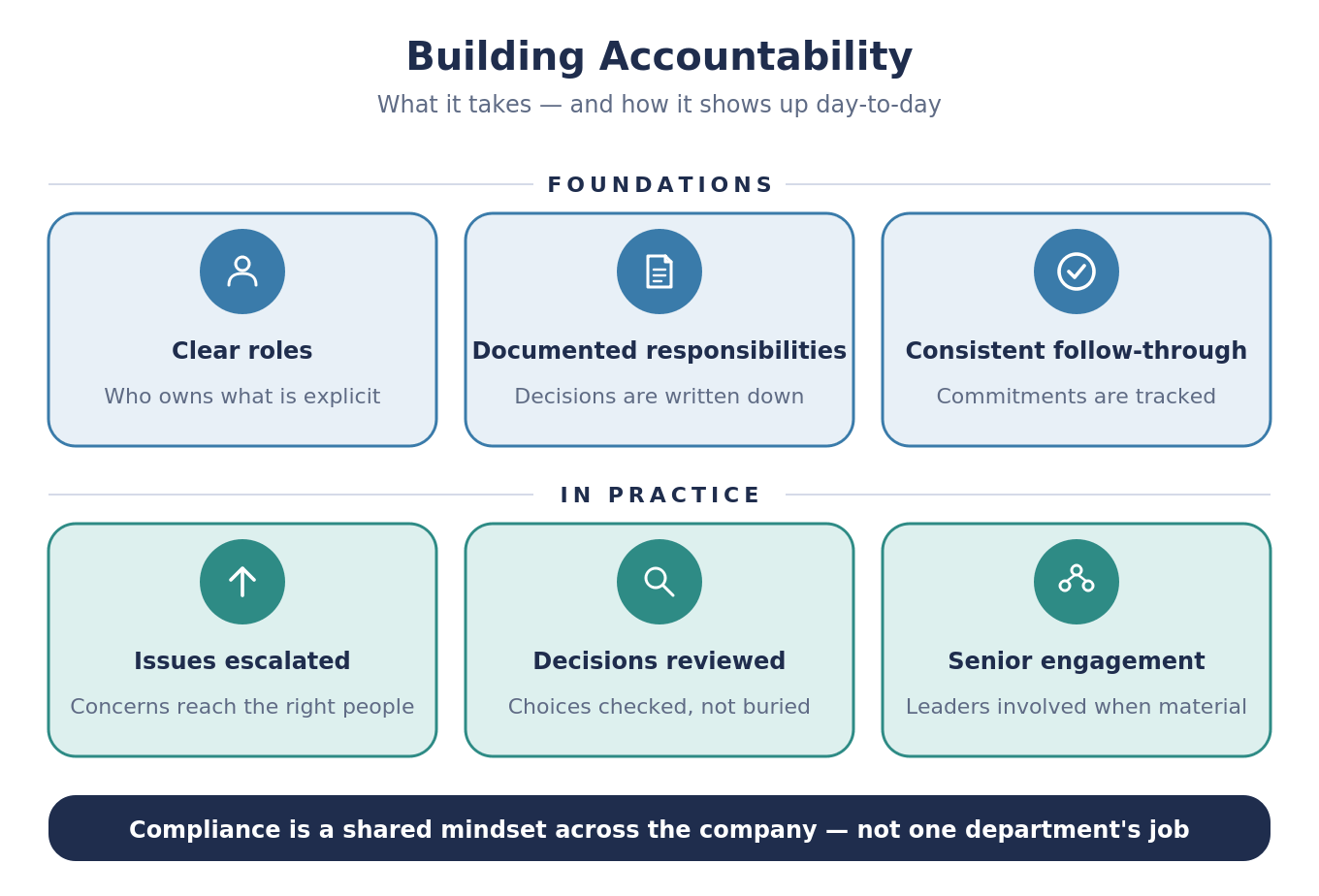
Accountability is established through:
Clear roles,
Documented responsibilities,
Consistent follow through.
Regulators expect firms to demonstrate that AML responsibilities are taken seriously at all levels. This means:
Issues are escalated,
Decisions are reviewed,
Senior leaders are engaged when necessary.
Early accountability makes scaling easier and reduces the risk of governance gaps later. Compliance is not the responsibility of a single department; it must be a shared mindset across the company.
Reaching the top of the AML maturity curve requires a culture where compliance is viewed as a driver of business growth rather than a hurdle to be cleared by a siloed team.
Learning checkpoint: What good looks like after step 9
At the end of this module, you should be able to:
Identify who owns AML responsibilities within your organization.
Explain the role and authority of the compliance officer.
Describe how training is tailored to different roles.
Explain how accountability and oversight are maintained.
If responsibilities are clearly defined and understood, your AML program is positioned to scale sustainably.
Preparing for step 10
In the final module, you will focus on scaling your AML program as the business grows, including when manual processes stop working and how to prepare for audits, partnerships, and renewal.